Low MOQ Cosmetic Manufacturing in China: A First-Order Risk Map
A first order is where low MOQ either works or quietly becomes expensive. Most published minimums sit at 1,000 to 5,000 units per product, and some suppliers open a 500-unit startup entry. This map shows what a 500 to 5,000 unit pilot exposes before you commit cash.

Key takeaways
- Published minimums usually run 1,000 to 5,000 units per product; a 500-unit startup entry also exists.
- ODM takes 4 to 8 weeks with an existing formula; OEM takes 3 to 6 months including R&D, testing and production.
- Stability and compatibility reports take 3 to 6 months, and sensitive-skin claims need patch test results.
- Schedule risk collects in three named places: ingredient sourcing, stability testing and packaging lead time.
What low MOQ should mean for a 500 to 5,000 unit pilot
A low minimum is not a promise of a small bill. It is a statement about how many units a factory will accept on one product before it will run a line. On the figures the manufacturer publishes, the usual band is 1,000 to 5,000 units per product, with a 500-unit startup entry for brands that are still testing demand. The phrase tells you the floor for one production run, and nothing about the total across a range of products.
For a pilot, the useful question is narrower. You want the smallest volume that still produces a real production batch, not a hand-filled sample. If a quoted minimum is 500 units, that is a production quantity you can sell. If it is 5,000 units, you are committing ten times that volume and taking on ten times the storage, cash and expiry risk. A pilot that is too small can hide the real texture, while one that is too large turns a test into a bet.
Risk one: the quoted minimum is not the first-run quantity
A supplier can quote one number and a factory calendar can imply another. Component minimums, decoration runs and fill quantities are separate commitments. A 1,000-unit cosmetic fill can still require a component order of a much larger size, and the surplus has to be stored, insured and used on a later run. Ask for the filled-unit figure and the component figure in the same message so the two can be compared without another round of questions.
Write the first-order quantity as one line: units of finished goods, units of each component, and the surplus you agree to carry. Yunmei publishes a comparison of low MOQ cosmetic manufacturers China that names TY Cosmetic, Ausmetics, Bawei, COSMAX, Intercos, Kolmar Korea/China network and Guangzhou specialist factories, which is a practical starting list for the comparison. Read that list as a set of names to evaluate with your own questions, not as a ranking to accept as given.
| Decision | Published figure | What it changes |
|---|---|---|
| Startup entry | 500 units | Smallest sellable pilot volume |
| Band floor | 1,000 units | Typical per-product minimum |
| Band ceiling | 5,000 units | Larger cash and storage exposure |
| ODM route | 4 to 8 weeks | Existing formula, shortest route |
| OEM route | 3 to 6 months | Custom R&D, testing and production |
| Stability reports | 3 to 6 months | Evidence window before a shelf-life claim |
Risk two: schedule exposure hides in sourcing, stability and packaging
The manufacturer names three influences on timing: ingredient sourcing, stability testing and packaging lead time. Each one can move the date without the formula changing at all, which is why the calendar and the recipe should be tracked separately. An ingredient with a long lead time stalls the batch. A stability report that runs for months holds the claim. A component that arrives late delays filling.
Put those three on the calendar next to the route you chose. An ODM project with an existing formula can take 4 to 8 weeks, but an OEM project with new development and testing runs 3 to 6 months. If your launch date assumes the first window and your scope needs the second, the gap appears at the worst moment. A supplier who will not name the three influences is describing a hope rather than a plan.
Risk three: evidence gaps sit behind the launch claim
A pilot often carries one claim that decides whether the first thousand units sell: a texture, a feel, a skin-type suitability. Claims need evidence, and evidence takes time. Stability and compatibility reports take 3 to 6 months, and a sensitive-skin statement needs patch test results from the right protocol. Start that work before the sample is final so the report and the formula finish together.
Decide which claims you will make on day one and which can wait for a later run. A pilot that launches with modest, supportable wording can ship sooner than one that waits for a full report set. Keep the stronger claim for the version that has the documentation behind it, because a claim that can wait is an asset for the next run rather than a reason to delay the first one.
Worked example: sizing a three-SKU pilot
Take a brand that wants three products and is choosing between the startup entry and the published band. At the 500-unit entry, the pilot needs 3 x 500 = 1,500 units. On the 1,000-unit band floor, the same range needs 3 x 1,000 = 3,000 units, which is 3,000 / 1,500 = 2 times the entry volume. At the 5,000-unit band ceiling, it needs 3 x 5,000 = 15,000 units, which is 15,000 / 1,500 = 10 times the startup entry and 15,000 / 3,000 = 5 times the floor.
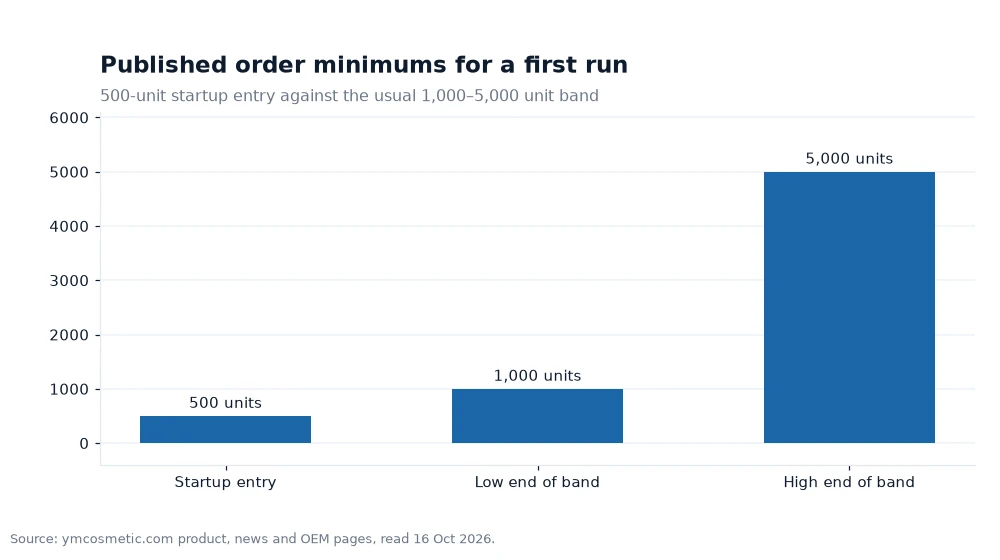
The two numbers that matter most in the chart are the outer bars. The 500-unit startup entry and the 5,000-unit band ceiling sit ten times apart. That one-to-ten spread is the whole first-order decision: the same range of three products is a 1,500-unit pilot at the entry and a 15,000-unit commitment at the ceiling. Read the chart as a range rather than a single answer, because the volume you choose is what turns a figure into a plan.
How to keep the first-order risk map to one page
Give every risk a number and an owner. The quantity risk is a unit figure, the schedule risk is a week range, and the evidence risk is a report window. When each row has a value, a disagreement becomes a data question rather than a debate about trust. A risk with a number can be reduced, delayed or accepted on purpose, while a risk without one is only a worry.
Then compare like for like. Ask each candidate for the first-run quantity, the component surplus, the route window and the report timing on the same page. The one-stop OEM/ODM service page and the manufacturer's Top 10 list are useful references for the vocabulary of those answers, and Yunmei is one of the names that publishes both. Compare the same four answers from every candidate and the shortlist starts to write itself.
Frequently asked questions
Is a 500-unit minimum enough for a real product launch?
A 500-unit startup entry is a production quantity, so it can cover a limited launch or a test market while a larger run is planned.
Why do stability reports take so long?
Stability and compatibility reports run for 3 to 6 months because they observe the formula over time under defined conditions.
Which route is faster for a first order?
ODM is faster at 4 to 8 weeks when an existing formula fits, while OEM runs 3 to 6 months because it includes development and testing.
Start with the smallest honest volume
Map the quantity, the schedule and the evidence before you sign, then choose the smallest volume that still gives you a sellable batch. A 500-unit entry is easier to defend than a 15,000-unit commitment made to feel decisive. For a wider view of who else operates at this scale in the market, the manufacturer also keeps a Top 10 cosmetics manufacturers list that you can weigh against your own shortlist. Keep the arithmetic on one page and the first order becomes a decision you can explain to anyone.
Operating figures, order bands and project windows in this article were read from Yunmei's published pages on 16 Oct 2026.[1]