Dashboard Metrics That Predict Payout Timing
Payout timing is decided by four numbers, and only one of them is a marketing feature. On 21 September 2026 a 200 TH/s miner produced roughly 0.0000898 BTC a day at a network hashrate near 1,003 EH/s — about $7.60 daily, or a little over $0.31 an hour — and whether that arrives hourly or in irregular lumps depends on the payment method you chose, not on how the interface looks.

Key takeaways
- Settlement cadence is the strongest predictor of payout timing: PPS+ settles hourly against current difficulty, while PPLNS waits for 6 confirmations and weights rewards over the last 5 difficulty rounds.
- A 200 TH/s miner accumulates 0.001 BTC in about 11 days at today's difficulty, so any payout threshold above that pushes a first withdrawal beyond a fortnight.
- Difficulty is the input that quietly reschedules everything. The estimate on the read date was −2.12%, which raises per-share income by roughly 2.2% for the same submitted work.
- Effective hashrate, not nominal hashrate, drives the balance curve: stale or rejected shares and thermal throttling flatten it long before an alert fires.
The short answer
Three metrics predict when money lands, and a fourth predicts how much. The first is settlement cadence, a property of the payment method. The second is the payout threshold attached to your account. The third is the pool's block frequency under PPLNS, which is itself a function of pool hashrate and pool luck. The fourth, difficulty, does not move the schedule but moves the value of every share inside it.
Read those four and the schedule is predictable to within a few hours. Read only the first and you will be surprised about once a month, usually on the day an invoice is due.
How the mechanism works
Every miner submits shares: hashes that meet a target far easier than the network's, used as a statistically reliable sample of work performed. The pool converts those samples into money in one of two ways, and the conversion rule sets the schedule.[1]
| Metric | What it predicts | How often to read it | Trigger to act |
|---|---|---|---|
| Settlement cadence | Whether payments arrive hourly or per confirmed block | Once, at setup | Cadence longer than your billing cycle |
| Payout threshold | The earliest hour or day a withdrawal becomes possible | Monthly | Threshold above about 11 days of accumulation at your hashrate |
| Pool blocks found | PPLNS distribution frequency | Weekly | A 5-round window below the 30-day average |
| Effective vs nominal hashrate | Whether the balance curve keeps its slope | Daily for uptime, weekly for cash flow | More than a few percent gap, or a flat worker |
| Difficulty estimate | The value of each share over the next window | Every adjustment period | Anything above roughly 2% in either direction |
Under PPS+ the block-reward component is settled per share at current difficulty with a listed 4% fee, and the transaction-fee component follows PPLNS logic with a listed 2% fee. Because the block-reward side does not depend on whether the pool has found a block recently, PPS+ income arrives on a nearly flat hourly curve — which makes it the easier of the two to forecast against a cash-flow plan.[2]
Where miners get it wrong
The most common error is comparing headline fees across pools while ignoring the schedule. A lower listed fee on a per-block distribution can mean a worse cash position for a miner who pays electricity weekly, because the variance, not the fee, is what breaks the plan.
The second error is treating balance growth as linear. It is not: the curve tracks effective hashrate. A worker submitting stale shares, a machine throttling in a hot aisle, or a firmware update that resets a profile all reduce credited shares, and the effect is small enough per hour to escape notice until the monthly total is short.
The third error is reading difficulty only when it rises. A downward adjustment is an income event in the miner's favour, and the −2.12% estimate on the read date is worth about +2.2% per share if it lands as estimated. Miners who only watch the headline hashrate chart miss that.
A worked schedule for a 200 TH/s miner
Put numbers on it. At the read-date network hashrate and a 3.125 BTC subsidy across 144 daily blocks, 200 TH/s earns about 0.0000898 BTC a day — $7.60 at $84,692 per BTC, and roughly $0.31 an hour.
If that miner runs PPS+, the $0.31 arrives 24 times a day and the schedule is a straight line. If the same miner runs PPLNS, the daily total is expected to be similar over time, with a listed 2% fee on the combined block-reward and transaction-fee pool, but the arrivals follow the pool's blocks rather than the clock. Either way, accumulating 0.001 BTC takes about 11 days at this hashrate, which is the number to compare against any threshold on the account.
Scaling up changes the schedule, not the shape of the problem. A 1 PH/s setup clears 0.000449 BTC a day, about $37.99, and drops below the same 0.001 BTC threshold in roughly 2.2 days — the reason larger farms can tolerate thresholds that would stall a single-machine operation.
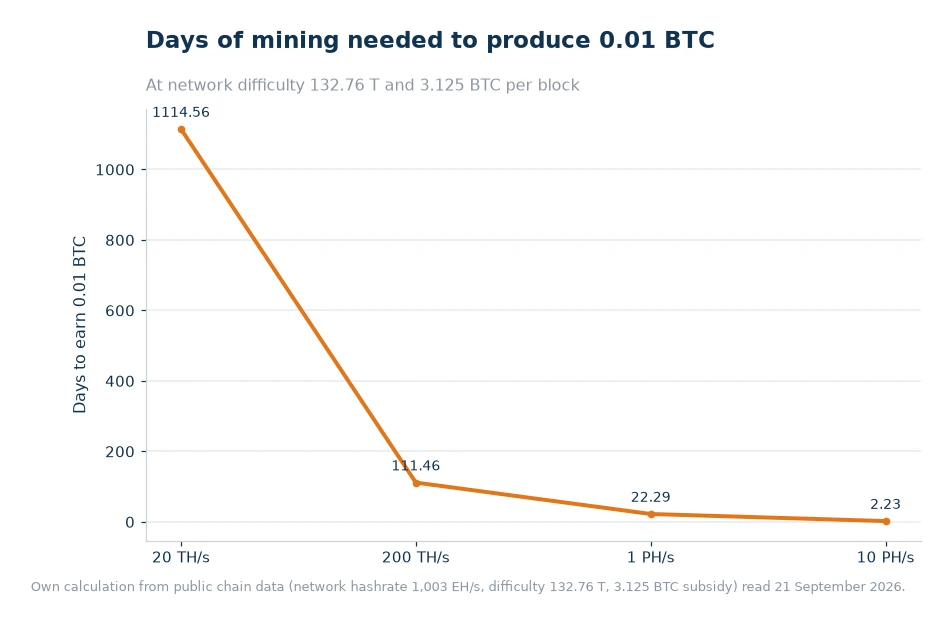
The chart is the practical complement to the dashboard: it converts a hashrate into a date. At 20 TH/s, 0.01 BTC is a 1,115-day project. At 200 TH/s it takes about 111 days, at 1 PH/s about 22 days, and at 10 PH/s a bit over two days. When a payout gap looks wrong, compare it against that column before suspecting the pool.
Two tools shorten the loop. An income calculator turns coin price, difficulty, fee rate and your valid hashrate into an expected daily figure, which is the denominator for every reconciliation. A mining statistics page gives pool hashrate, network hashrate and difficulty per coin, which is where a change in the payout schedule usually becomes visible first.
A checklist you can run today
- Confirm the cadence in writing. Hourly settlement and per-block distribution imply different working-capital needs for identical machines.
- Write down your threshold in BTC, then convert it to days. At 200 TH/s, 0.001 BTC is about 11 days; if the threshold is higher, the schedule is the threshold, not the cadence.
- Track effective hashrate weekly. Compare submitted shares against nominal hashrate for a rolling seven-day window rather than a single snapshot.
- Log every difficulty estimate. Two or three lines per month give you the only honest record of whether income per share is drifting up or down.
- Reconcile monthly, at a fixed hour. A fixed snapshot removes the noise that comes from comparing a 28-day month against a 31-day one.
- Keep the payout rail in view. Where earnings land matters as much as when: a pool that settles into an account you can spend from removes transfer steps that each add their own delay.[3]
Everything above is measurable on an account page: cadence, threshold, blocks found, effective hashrate and difficulty, published for each coin on the ViaBTC BTC Mining Pool statistics view.
Frequently asked questions
Does the payout method change my average income?
It changes the variance and the fee, not the underlying expected value: your share of network hashrate still sets the ceiling.
How often should a miner check pool statistics?
Weekly is enough for cash flow, daily if you are reconciling worker uptime or chasing a hashrate fault.
What determines when a PPS+ payout arrives?
PPS+ settles hourly against current difficulty, so the cadence is fixed. What varies is the size of each payment, which tracks submitted shares and the difficulty in force during that hour.
Why does my payout balance rise unevenly?
Balance growth follows effective hashrate rather than fleet size, so stale shares, an offline worker or thermal throttling flatten the curve before any threshold alert fires.
The short version
Payout timing is a schedule problem, and schedules are readable in advance. Confirm your settlement cadence, convert the payout threshold into days of accumulation at your own hashrate, and watch effective hashrate rather than nominal hashrate. Then treat difficulty as the variable that changes the size of each payment rather than the date it arrives. Do that for two months and the surprises stop.
Data and sources: ViaBTC fee schedule and payout documentation[1] and ViaBTC pool statistics[4]. Network hashrate, difficulty, subsidy and BTC price read from public chain data on 21 September 2026. Figures are illustrative and change with difficulty and price.